
Let’s be honest.
Science can easily become the “squeeze it in if we have time” subject in elementary classrooms. Between reading blocks, math interventions, small groups, behavior support, and everything else we carry… science sometimes gets whatever energy is left.
And when we’re tired, it’s easy to default to worksheets.
But student engagement in science doesn’t require elaborate labs, expensive materials, or hours of prep. It requires intentional structure and simple shifts in how we deliver content.
If your science block feels rushed or low-energy, these five low-prep science activities can completely shift the tone of your classroom.
1. Start With a Simple Phenomenon
You do not need a full lab setup to spark curiosity.
A short video clip.
A surprising image.
A quick demo with materials you already have.
Ask students:
- What do you notice?
- What do you wonder?
- Why do you think this is happening?
Example:
When teaching states of matter, show a short clip of dry ice bubbling in water or simply drop an Alka-Seltzer tablet into water in front of the class.
Students immediately ask:
- Where is the gas coming from?
- Is that smoke?
- Why is it bubbling?
From there, you build into solids, liquids, and gases.
Low prep. High engagement.
This strategy works because students are investigating before you ever open the textbook.
2. Turn a Worksheet Into a Movement Activity
You don’t have to throw away your worksheet. Just change the structure.
Example:
If you’re reviewing food chains:
Instead of handing out a paper with 10 questions, cut the questions apart and tape them around the room.
Students rotate in pairs with clipboards and answer each question at a different station.
Or:
Post ecosystem scenario cards and have students move to the one they think shows a producer, consumer, or decomposer.
Movement increases focus.
Focus increases retention.
Retention increases confidence.
Same content. Completely different energy.
3. Use a Quick Choice Board for Review
Choice increases ownership, and ownership increases engagement.
You don’t need a complicated template.
Example:
After a unit on plant adaptations, give students these five options:
- Draw and label a plant with three adaptations.
- Write a short paragraph explaining one adaptation.
- Create three quiz questions about plant survival.
- Act out how a plant survives in a desert.
- Build a simple model using classroom supplies.
Set a timer for 20–25 minutes. Clear expectations. Clear rubric.
When students choose how they show learning, resistance drops and work completion improves naturally.
Choice does not mean chaos. It means structured autonomy.
4. Simplify Claim-Evidence-Reasoning
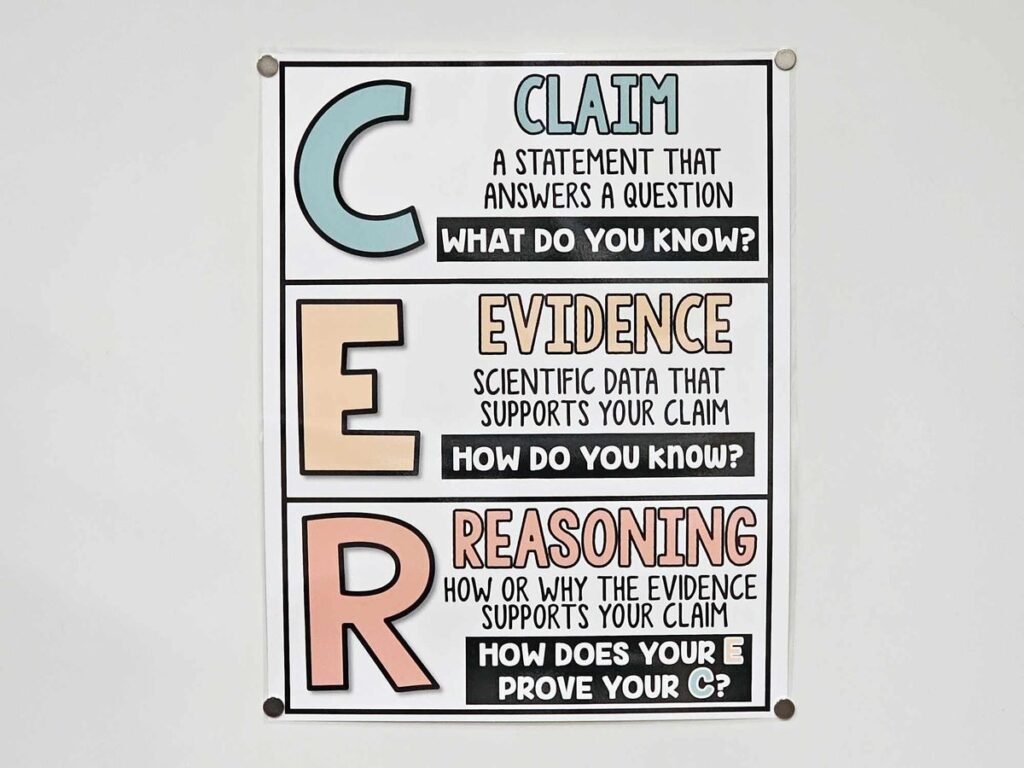
CER does not have to be complicated in elementary classrooms.
Start with:
“I think ______ because ______.”
Example:
If you’re teaching erosion, show two images:
- One with plant roots holding soil in place
- One with exposed soil after heavy rain
Ask:
“Which area will erode more?”
Students respond:
“I think the area without plants will erode more because the roots are not holding the soil.”
You can chart a few responses together and highlight:
- Claim
- Evidence
This builds academic confidence without overwhelming students.
Students feel smarter when they can explain their thinking.
5. Build Structured Science Talk Into Every Lesson
Engagement skyrockets when every student talks, not just the confident few.
Example:
During a lesson on weathering:
- Ask: “What causes rocks to break down?”
- Students write one idea.
- Turn and talk using this sentence starter:
“One cause of weathering is ______ because ______.” - Partner A summarizes Partner B’s thinking.
You can also use:
- Talking chips
- Numbered heads
- Think-Write-Share instead of just Think-Pair-Share
When talk is structured, participation becomes predictable and safe.
Science becomes collaborative instead of performative.
Final Thoughts
Elementary science does not have to be complicated to be engaging.
You don’t need elaborate labs.
You don’t need Pinterest-perfect materials.
You don’t need hours of prep.
You need:
- Curiosity
- Structure
- Student voice
- Ownership
Start with one strategy this week. Watch what happens.
Engagement grows when students feel curious, capable, and involved.
And that shift doesn’t require more time, just intentional design.
Stay curious & teach boldly,
Jade